


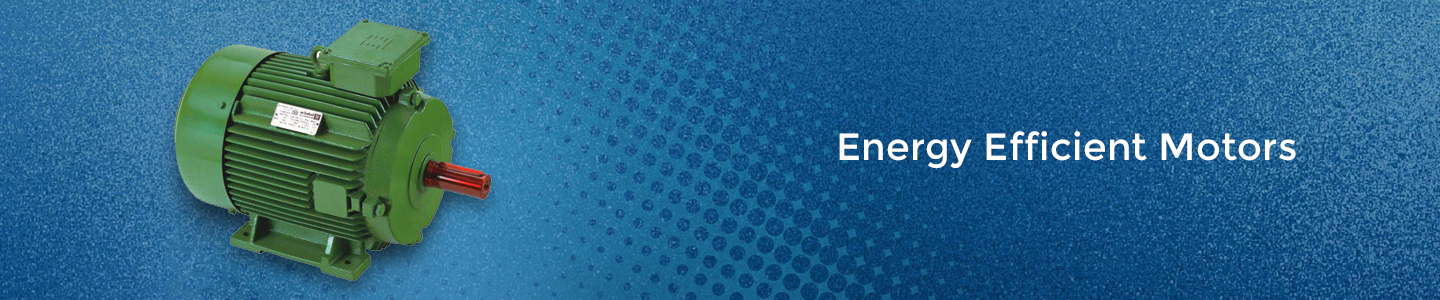
Energy efficient banner
- rated voltage ≤ 1000V
- rated output 0.37kW to 375kW
- either 2, 4 or 6 poles
- meet frame size to output relation as stipulated in IS:1231 (for outputs covered by IS:1231)
- rated on the basis of either duty type S1 (continuous duty) or S3 (intermittent periodic duty) with rated cyclic duration factor of 80% or higher
- capable of operating direct on-line
- designed for operation on virtually sinusoidal and balanced voltage conditions as defined in 7.2.1 of IS/IEC 60034-1
- designed for an ambient temperature not exceeding 40°C and altitude not exceeding 1000m
- degree of protection IP44 or superior
- method of cooling IC411 in accordance with IS 6362/IEC 60034-6
- service factor not exceeding 1.0.
- IE1 = Standard Efficiency (comparable to EFF2) (only for variable frequency drive application).
- IE2 = High Efficiency (comparable to EFF1)
- IE3 = Premium Efficiency
- IE4 = Super Premium Efficiency
- Rated voltage up to 1000V
- Rated output between 0.75kW and 375kW
- 2, 4, or 6 poles
- Rated on the basis of continuous duty (S1) or intermittent periodic duty (S3) with a cyclic duration factor of 80% or higher
- Capable of operating direct on-line
- Rated for operating conditions in accordance with IEC 60034-1 (temperature, installation altitude.etc.)
- Motor with feet, flanges and/or shafts with mechanical dimensions different from IEC 60072-1 are covered by this standard.
Energy Efficient Motors IE2/IE3
CONSTRUCTION
The new IS: 12615-2011 is based on the International Standard IEC: 60034-30 (2008)
Under the ambit of IS: 12615-2011 the following single speed, three phase, 50Hz, squirrel cage induction motors are covered
FEATURES
| Frame Size | 71 to 355 |
| Power Range | 0.37kW to 315kW |
| Number of Poles | 2,4,6 |
| Efficiency Class | IE2 and IE3 |
| Degree of Protection | IP55 as per IS:4691 |
| Voltages | 415V standard (other voltages available) |
| Frequency | 50 Hz |
| Cooling Type | IC411 as per IS:6362 |
| Symbols of construction & mounting arrangement | IS:2253 |
FAQ & KNOWLEDGE BASE
Energy Efficient Motors
The new IS: 12615-2011 defines the following efficiency classes of low-voltage three phase asynchronous motors in the power range from 0.75 kW to 375 kW.
The main difference between the efficiency classes (EFF and IE) lies in the method used to determine them. In a direct comparison of both measuring methods for the same motor, it is expected that the new method of determining efficiency levels will show a reduction in the measured efficiency level for the motor.
For example, an EFF1 motor with a 91.0% efficiency is physically identical to an IE2 motor with 89.8% efficiency.
The efficiency class system specified under IEC 60034-30 is valid for low voltage three phase cage-induction motors with the following specifications:
The new test standard has been changed to be more accurate and consistent and now uses different test methods so the same motors will have different efficiency figures depending on which test standard is used. Also, IEC 60034 – 2 -1996 and the new 60034-2-1 (2007) have different definitions which are not exactly the same. This means that the same motor could probably have different efficiency levels under the two standards.
New measuring methods: With the new measuring methods, the additional losses are no longer assumed as fixed percentage values (with 0.5%), but are determined by making the appropriate measurements (IEC 60034-2-1: 2007). This is the reason that the nominal efficiencies decrease from EFF1 to IE2 and from EFF2 to IE1 - although neither technical nor physical changes have been made to the motors.
Previously: PLL = 0.5 % of P was added
Now: PLL = Individual measurement
PLL = Load dependent additional Losses
As an example, the efficiency values for 3 motors according to the new and the old loss determination methods are shown in the following table:
| Old EFF measuring methods(incl. fixed percentage losses) IEC 60034-2: 1996 50 Hz | New loss determination methods according to IEC 60034-2-1: 2007 50 Hz | |
|---|---|---|
| 5.5 kW 4-Pole | 89.2 % | 87.7 % |
| 45 kW 4-Pole | 93.9 % | 93.1 % |
| 110 kW 4-Pole | Not Defined | 94.5 % |